
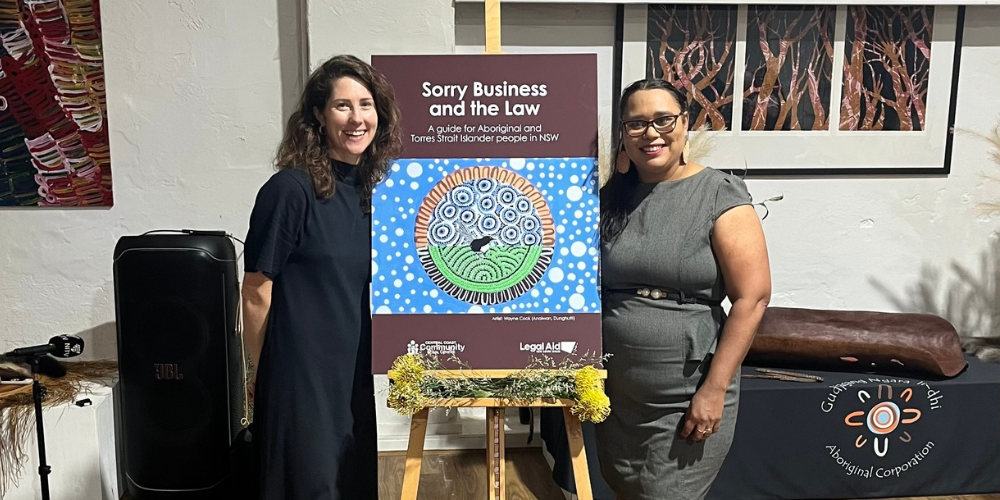
(Image: Winnecke Baker, Legal Aid NSW, and Bobbi Murray, Community Legal Centres NSW, at the launch of 'Sorry Business and the Law'. Artwork for the cover of the guide and the poster is by Wayne Cook (Anaiwan, Dunghutti).)
The death of a loved one can bring up a range of legal and practical responsibilities, often at a time when families are grieving and navigating important cultural obligations.
For Aboriginal and Torres Strait Islander communities, these responsibilities can intersect with the cultural customs, kinship systems and obligations that are central to Sorry Business.
A new resource, 'Sorry Business and the Law', brings together clear, practical information to support Aboriginal and Torres Strait Islander people across NSW to navigate the legal and practical processes that can follow the death of a loved one. The guide provides step-by-step information while recognising the cultural significance of Sorry Business.
The guide was launched on Darkinjung Country at Gudjagang Ngara li-dhi Aboriginal Corporation on Tuesday 18 November 2026.
Origin of the guide
The idea for the guide grew out of CLCNSW Sector Development Manager Bobbi Murray's community legal outreach work with Central Coast Community Legal Centre nine years ago.
During this work, Bobbi heard about a young Aboriginal man who, at just 18, was left to navigate funeral arrangements and legal processes following the death of his mother.
As Bobbi explains:
“One story in particular highlighted the need for a practical resource. Community members shared the experience of a young Aboriginal man, barely 18 years old, who had been the primary carer for his mother. When she passed away from her struggle with cancer, he was left to navigate funeral arrangements, legal processes and administrative requirements while also dealing with the grief of losing his mum. Fortunately, he sought support from a respected local community member."
Bobbi said the community then "did what community always does – People stepped in, people shared knowledge, people lent their support, and together they helped give his mother the farewell that she deserved. After hearing that story, I couldn't stop thinking about people who might not know who to ask, the people who didn't know where to start, the people who are carrying grief, and at the same time being expected to make legal, financial and practical decisions."
"That story stayed with me, and it became the beginning of this project."
A resource for community
Community input and lived experience were fundamental to the development of the guide. The launch heard from respected Elders and community members BJ Duncan, Karen Adams, Avron Lincoln and Wayne Cook.
Bobbi also spoke at the launch, saying: "When people pick up this booklet, they'll see a practical resource, but for me, and I suspect many people in this room, it represents something much bigger than that. It represents years of conversations, years of listening, years of persistence and above all, it represents community."
"The idea for this project came from listening to community."
Over the years, those conversations highlighted the need for clearer, more accessible information.
"People needed somewhere to start, practical guidance that brought things together in one place", and that needs to be in a format that is accessible, practical, culturally respectable.
"Information is only useful if people can actually access it and use it," Bobbi said.
"When somebody passes away, life doesn't pause. There are funeral arrangements, questions about who can make decisions, questions about wills, questions about estates, questions about government agencies, paperwork and responsibilities, and all of that often comes while people are trying to grieve. For many Aboriginal families, it also sits alongside cultural responsibilities and obligations that are equally important."
"This resource won't take away that grief, but it what it can do is help make that pathway a little clearer."
Community Legal Centres NSW congratulates Bobbi and everyone involved in bringing this project to fruition. We acknowledge the Central Coast Aboriginal community for their guidance and ongoing contribution to the resource.
As Bobbi said:
"This resource exists because people willing to share their knowledge, their experiences, and sometimes their hardest stories - so that others might benefit in the future. I also think there's an important message here for government organisations and services: This project reminds us what can happen when you genuinely listen. When community identifies needs, organisations work together, and people remain committed to seeing something through."
Read Sorry Business and the Law here and share it with your communities.